|
WheelchairDriver |
|
||
 |
| ||
|
WheelchairDriver |
|
||
|
|
| ||
|
|
CHARGING Almost ANY charger will work on any lead based battery to a large degree. However, if you want to get the best service life from your investment then read the following carefully. There isn't a single charger on the planet that can correctly AUTOMATICALLY charge both AGM and GEL batteries and know which is which. The charger does NOT know which battery is on the end of the cable. Contrary to what you may have read on other less well informed sites. So if you don't want to drastically shorten the life of your expensive batteries you MUST choose the correct charger for each battery type. This isn't very easy, as most manufacturers do not say, or give full detailed charge algorithm details or voltages or other specs! They just claim that they can charge all batteries. This is true, but not properly! So you need to find out one way or another, or do as I do and simply use a charger that is totally USER adjustable in all of its settings. The "automatic", "charge all", AGM/GEL chargers simply do neither correctly. Most simply charge at 14.4v (28.8 for two batteries) and hope all works out OK for all types. Well they do charge both in a fashion. But they seriously shorten the service life of the Gel battery, possibly undercharge the Pure Lead batteries like Optima, Exide pure lead, Odyssey, Di-hard rebrands etc. So they are not very clever. So they work, but badly.
CORRECT CHARGE MK states for their GEL batteries at 20C / 65F room temperature to charge using the following parameters: CC (Constant Current - stage 1) This is the max power of the charger, we are limited to around 8 to 12 Amps due to the charging connector on most powerchairs. Otherwise around 20 (1/3rd its capacity) is a better figure. This isn't critical it just takes longer to 14.10v MAXIMUM. Charging to higher than 14.10V per battery shortens service life quite seriously. Even a few tenths of a volt is a problem here! CV (Constant Voltage - stage 2) This is where Voltage is held at 14.10 Volts until the current (Amps) naturally tails off to an extremely low level. This should be well under .7 of an amp, preferably much less. (1/100C to 1/500C is suggested by MK or 8 hours). FLOAT (Float is a final indefinite stage) Voltage is held around 13.5v to finalise charge over time and to prevent self discharge if unused giving long term protection. MKs own tech spec for charging their Gel correctly is here A gel battery typically takes double the time to charge compared to say the Odyssey I use. The Odyssey charges much faster because of 2 things. Less surface charge effect & a greater difference between charger voltage and battery terminal voltage.
ODYSSEY AGM (normal AGM) states for their batteries at 20C room temperature to charge using the following parameters: CC (Constant Current - stage 1) This is the max power of the charger, we are limited to around 8 to 12 Amps due to the charging connector on most powerchairs. NO AMP LIMIT needed if connected directly to 14.70v (14.4V) MAXIMUM. Charging to higher than 14.7V (14.4V AGM) per battery shortens service life. CV (Constant Voltage - stage 2) This is where Voltage is held at 14.70 (14.4) Volts until the current (Amps) naturally tails off to an extremely low level. This should be well under .7 of an amp, preferably much less. (1000thC or 0.07 Amp is suggested by Odyssey for best cycle life). Cutting charge short, also shortens service life. FLOAT (Float is a final indefinite stage) Voltage is held around 13.6v to finalise charge over time and to prevent self discharge if unused giving long term protection. Odyssey own tech specs inc charging is here If you want - just ignore the above, its easier to say, hold it at 14.7v until it no longer pulls enough amps to measure... (1000C) Done!
As you can see here, its impossible for one charger to charge at both 14.10V (Gel) and 14.4V (AGM) or 14.7V (Odyssey/Optima/Stinger/Di-Hard rebrands etc.) So it is essential to use a correct charger for your specific battery or drastically shorten the service life of that battery. Not sure what yours does? Get a GOOD digital volt meter and monitor the voltage towards the end of charge.
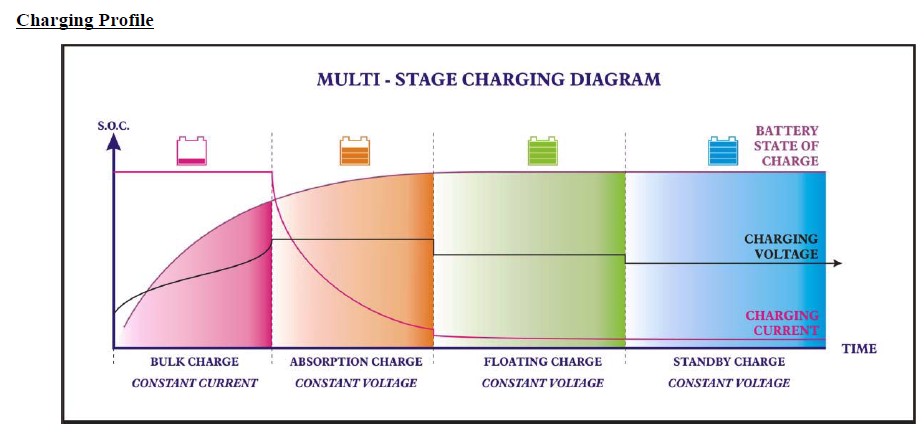
RED SECTION STAGE 1 (CC or BULK) SHOWS CHARGER AT FULL POWER AND BATTERY VOLTS CLIMBING. If you had a powerful enough charger this "stage" wouldn't exist, and it would just jump up to the CV stage instantly.ORANGE SECTION SHOWS STAGE 2 (CV or ABSORPTION) WHERE THE VOLTAGE IS HELD STEADY AT EXACTLY 14.1V (GEL), 14.4V (AGM), OR 14.7V (PURE LEAD LIKE ODYSSEY) AS SOON AS THIS STAGE ENDS, YOUR CHARGER SAYS DONE!!! ITS NOT... ITS ABOUT 98 PERCENT DONE. GREEN SECTION (STAGE 3 FLOAT) CONTINUES AT A LOWER VOLTAGE INDEFINITELY. IT FINALISES THE CHARGE TO 100 PERCENT NEEDED TO PREVENT BATTERY KILLING SULPHATION, THEN PROTECTS AGAINST SELF DISCHARGE & CAN BE LEFT CONNECTED FOREVER. 13.5V TO 13.8V IN CYCLIC USE. BLUE SECTION, NOT MANY CHARGERS DO THIS. YOU CAN IGNORE THIS. THEY USUALLY CONTINUE WITH THE GREEN PART INDEFINITELY AT 13.5V. IT IS A JUST A FURTHER DROP IN VOLTAGE FOR VERY LONG TERM (MONTHS +) OF STORAGE, AT 13.2V AND NOT REALLY IMPORTANT IN A POWERCHAIR DAILY CYCLIC CHARGER.
SUMMARY PURE LEAD AGM E.G. ODYSSEY (rebranded as Di-Hard etc, stinger and all the rest Optima, Exide Pure lead spiral etc) HI AMP capability, needed if your chair is programmed to go, want some some power on ramps, off road, sport use, fast charging, etc GEL best cycle life of all provided it is CORRECTLY charged, not at 14.4v (28.8v) as most mobility/universal chargers do. Less good for powerful chairs, steep hills, sport, off road. You FEEL the voltage sag as you try to get the power in these situations. They get much worse as they become discharged. The internal resistance increases as the battery charge becomes used up. In a slow chair, or a chair with delays programmed in, as most are, you would never notice this.
Burgerman.
|
|
Content, Images, Software & Design (c) Burgerman 1996 & aggressively protected by whatever means needed -- Message Board |